
An Explanation of the 8 Basic Rules of "Easy Japanese" That Anyone Can Understand
2026/03/31
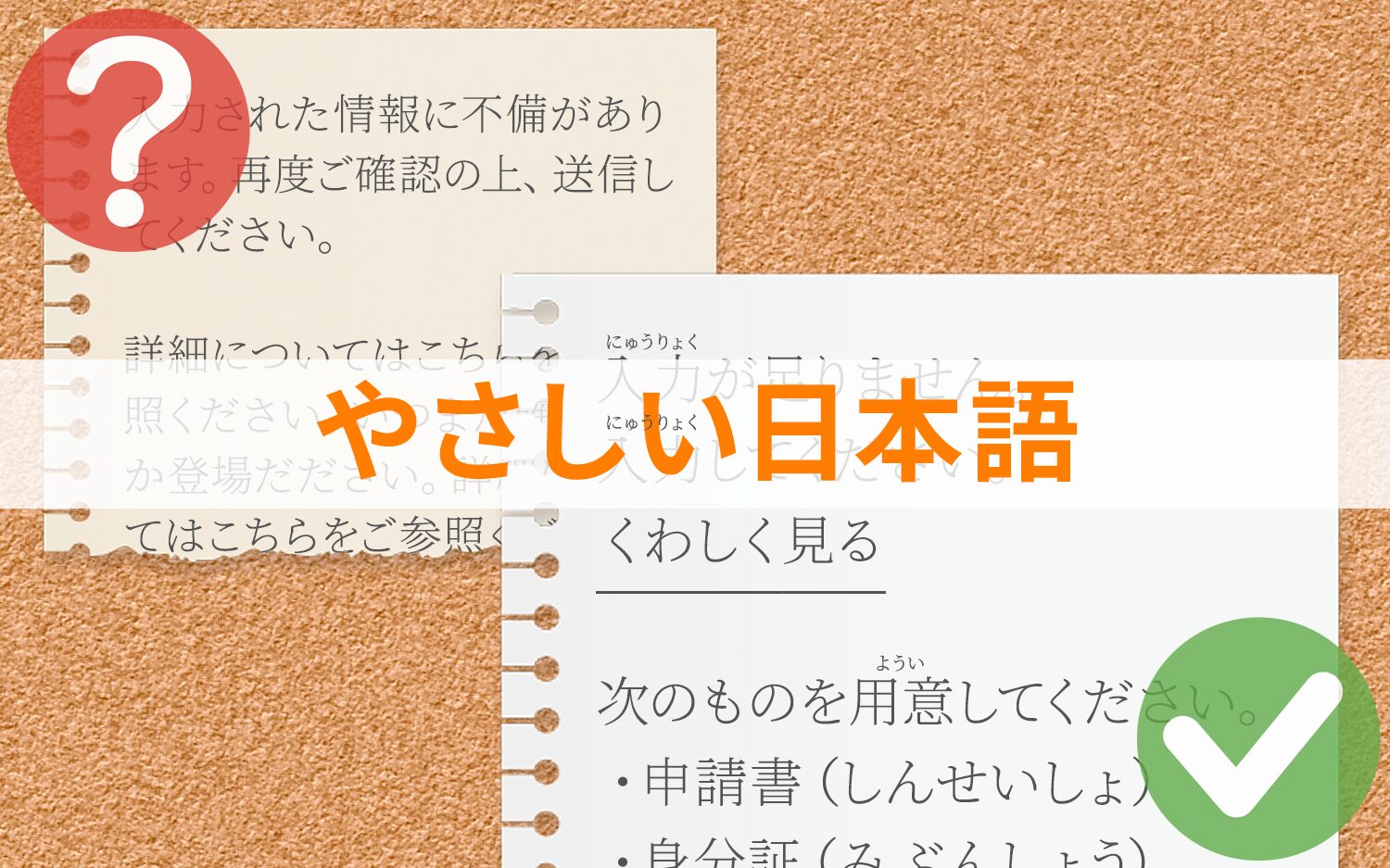
Easy Japanese"Easy Japanese" refers to Japanese that avoids difficult words and complex phrasing to make it easier for the listener to understand. For example, in Easy Japanese, the following would be rephrased as follows:
Standard Japanese"For more details, please click here."
Easy Japanese"Click here for more details"
Simply rephrasing it this way can make a big difference in how clear the text is. Even the Agency for Cultural Affairs promotes "easy Japanese,"An effective way to reach a diverse audience, including foreign nationalsWe position it as...
In fact, "Easy Japanese" is becoming increasingly widespread, particularly in the context of information dissemination by local governments. This trend is driven by the growing number of foreign residents in Japan and the increasing diversity of their nationalities and regions of origin.
According to the Immigration Services Agency, as of the end of June 2025,The number of foreign residents is 3,956,619And so, we set a new record high. Amid these changes,Government agencies and businesses are expected to communicate information in a way that reaches a wider audience.
Citation: Number of Foreign Residents as of the End of June 2025 (Immigration Services Agency)
However, the need for simplified Japanese is not limited to addressing globalization.
In April 2024, the revised Act on the Elimination of Discrimination against Persons with Disabilities came into effect, making it mandatory for businesses to provide reasonable accommodations.Ensuring that everyone can access information and receive it in a format that is easy to understandThis is becoming increasingly important from the perspective of reasonable accommodation as well.
In this article, we will provide a detailed explanation of the basic principles of easy-to-read Japanese, the eight basic rules for rephrasing, and the use of easy-to-read Japanese on websites.
Table of Contents
- 1 The Difference Between Standard Japanese and "Easy Japanese"
- 2 The 8 Basic Rules of "Easy Japanese"
- 2.1 Rule 1: Organize the information and convey the most important points first
- 2.2 Rule 2: Keep sentences short
- 2.3 Rule 3: Clearly define who does what
- 2.4 Rule 4: Use bullet points
- 2.5 Rule 5: Avoid using loanwords (words of foreign origin) as much as possible
- 2.6 Rule 6: Do not use double negatives
- 2.7 Rule 7: Minimize Ambiguous Language
- 2.8 Rule 8: Be mindful of the number of kanji used, and add furigana as needed
- 3 Examples of "Easy Japanese" in Practice: Adachi Ward, Tokyo
- 4 The Importance of "Easy Japanese" in Web Accessibility
- 5 "UniWeb": Achieving Web Accessibility Compliance at Low Cost and in a Short Timeframe
- 6 Conclusion
The Difference Between Standard Japanese and "Easy Japanese"
The easiest way to understand simple Japanese is to compare it with standard Japanese. With that in mind, we’ve compiled the following table to illustrate the differences between standard Japanese and simple Japanese, using expressions commonly found on websites as examples. Please take a look.
◆Comparison of Standard Japanese and Easy Japanese
| Scene | Standard Japanese | Easy Japanese | Areas for improvement |
|---|---|---|---|
| Error message | There are errors in the information you entered. Please review it again and resubmit. | Some fields are missing. Please fill them in. | Eliminate vague phrases like “incomplete” or “please check again,” and clearly specify what the problem is. Also, make it clear what steps should be taken next. |
| The email address format is incorrect. | The email address is entered incorrectly. Please check it again. | Avoid using abstract terms like "form" and instead use phrasing that makes it clear what needs to be corrected, while also specifying the necessary actions. | |
| Link button | For more details, please click here. | View detailed information about the service | Change "Please refer to" to a shorter, clearer phrase. Also, make sure the wording clearly indicates what users will find when they click. |
| If you would like to apply, please follow the link below to complete the process. | Click here to apply | Summarize lengthy explanations into concise statements that encourage users to take immediate action. Also, make the buttons more intuitive. (Short text and design) | |
| Automatic reply after your inquiry | Thank you very much for contacting us regarding our services. Our staff will review the information you provided and get back to you shortly. Please note that depending on the nature of your inquiry, it may take some time for us to respond. | Thank you for your inquiry. We will review your message and have a representative contact you. Please note that it may take a few days for us to respond. | Break long sentences into shorter ones and simplify honorific expressions. Rearrange the information in an order that is easier for readers to understand. |
| Due to a high volume of inquiries at this time, it may take longer than usual for us to respond. | Due to the high volume of inquiries we are currently receiving, our response times are longer than usual. | Avoid formal expressions such as "concentrate" and "please accept," and describe the situation using everyday language. | |
| The beginning of the Privacy Policy | We will comply with the Act on the Protection of Personal Information and other relevant laws and regulations regarding the personal information we collect from users, and will manage and handle such information appropriately. | This site will handle your personal information (such as your name and email address) appropriately in accordance with the law. | We soften the formal language typical of legal texts and clarify what “personal information” refers to by providing specific examples.
*This is not the official text of the terms and conditions; it is intended to serve as a brief summary at the beginning. |
| We will use the personal information we collect for purposes such as providing services, verifying identity, and responding to inquiries. | We use the personal information we collect to provide our services, verify your identity, and respond to your inquiries. | Replace formal expressions such as "collect" and "use" with more natural phrasing. Make the intended use a bit more specific to make it easier to understand. |
Looking at this table, it becomes clear that "easy Japanese" is not merely a matter of rephrasing, but rather,Rewrite ambiguous expressions so that users can easily understand themYou can see that this is the case.
For example, phrases such as “There are some issues,” “Please refer to,” and “We have received” are commonly used, but depending on the reader, they may be difficult to understand or feel cumbersome due to the number of characters.
Especially on websites, where people often skim through information quickly and move on to the next step,This lack of clarity can sometimes lead directly to people leaving or misunderstandings.
In addition, "Easy Japanese" is,Consider not only readability but also ease of useThis is also an important point. It’s crucial that users understand what needs to be fixed if they see an error message, what happens when they click a button, or how long they should wait if they receive an automated reply.
In other words, "easy Japanese" is not only a matter of crafting sentences, but alsoAn Approach to Enhancing the Customer Experience Across ChannelsBut that’s the way it is.
Even with formal documents like privacy policies, simply adding a clear explanation at the beginning can make a big difference in how easy they are to understand. While it’s sometimes difficult to simplify all the information in policies and terms of service uniformly,At least at the initial entry point, the content should be presented in a way that allows users to grasp it without confusionThis is crucial.
In this way, "easy-to-understand Japanese" can be described as a practical approach designed to ensure that information is accessible not only to the elderly and foreign nationals, but to a wide range of people.
The 8 Basic Rules of "Easy Japanese"
Now, let me outline eight “basic rules” you should keep in mind when writing in simple Japanese.
◆Basic Rules of Easy Japanese
② Keep sentences short
③ Clearly define who does what
④ Use bullet points
⑤ Avoid using katakana words (loanwords) as much as possible
⑥ Avoid using double negatives
⑦ Reduce vague language
⑧ Be mindful of the number of kanji used, and add furigana as needed
I will explain each of these in detail below.
Rule 1: Organize the information and convey the most important points first
In simple Japanese, the basic principle is to organize what you want to convey and present the most important information first. If the order of the information isn’t organized, the message will be difficult to understand, even if the words used aren’t complicated.
For example, if background information, precautions, and supplementary details are all included in a single paragraph of text, it can be difficult to tell what is most important. Therefore,First, state what you need to convey to the other person, and then continue with the necessary explanationIt is important to...
◆Example
| Standard Japanese | Easy Japanese |
| This procedure is necessary to verify the details of your application and confirm your identity. Please note that we may be unable to accept your application if the required documents are incomplete, so please check the list of required items in advance before visiting our office. | Please bring the necessary documents to the service counter. We cannot accept your application unless all the required documents are submitted. |
Especially on the web, it’s crucial that the main points come across in the first few lines.Similarly, even in printed brochures or booklets, it’s easier to grasp the content when key points are presented first. Regardless of the medium, the principle of conveying important information first remains the same.
Rule 2: Keep sentences short
It is important to keep sentences short and avoid cramming too much information into a single sentence. The longer a sentence becomes, the harder it is to grasp the relationship between the subject, the conditions, and the conclusion, which makes it more difficult for the reader to follow.
◆Example
| Standard Japanese | Easy Japanese |
| Please note that if there are any unclear points in your application, the person in charge may contact you for clarification. | If we are unsure about the details of your application, we will contact you. At that time, please assist us with the verification process. |
In particular, when it comes to guidance and explanatory text,Don’t include too many reasons or conditions in a single sentenceIt is important to keep this in mind. If you want to convey two or more ideas, it is easier to understand if you break them into separate sentences rather than forcing them into a single sentence.
Rule 3: Clearly define who does what
In simple Japanese, it’s important to clarify who is doing what, that is,Make the subject and predicate clearThis is important. If the subject is omitted or there are many passive constructions, it becomes difficult for the reader to correctly understand “who is doing what.”
◆Example
| Standard Japanese | Easy Japanese |
| The required documents will be returned to you after they have been checked at the counter. | The staff member at the counter will verify the required documents. After reviewing them, I will return the documents. |
When it is clear who is taking action, the meaning of the text becomes easier to grasp, and the content of procedures and instructions is less likely to be misunderstood.
Rule 4: Use bullet points
When a paragraph contains a lot of information, it’s a good idea to use bullet points instead of trying to cram everything into a single paragraph. In particular,When conveying procedures, conditions, precautions, and items to bring, a bullet-point list is easier to understand than a continuous paragraph.
Simple Japanese isn't just about rephrasing words,Organize information in an easy-to-read formatThis is also important.
◆Example
| Standard Japanese | Easy Japanese |
| When applying, please bring your identification, application form, copies of the required documents, and the application fee, and visit the service counter during business hours. | When applying, please bring the following items with you.
・Identification documents Please come to the counter during business hours. |
In particular,When listing three or more items, it’s easier to convey the information clearly by using a bulleted list rather than writing it out in paragraph form.Simple Japanese and bullet points go hand in hand when it comes to improving readability.
Rule 5: Avoid using loanwords (words of foreign origin) as much as possible
When using simple Japanese, try to replace katakana words and loanwords with terms that are as easy to understand as possible. Even words used in everyday conversation may not convey their meaning to everyone, andThis can sometimes make it difficult to understand, especially for people who are not familiar with Japanese, such as foreign visitors to Japan.
However, it is not necessary to replace every loanword. For example, words like “bus,” “gas,” and “television,”If there is no appropriate Japanese equivalent for a word other than a loanword, it is perfectly fine to use it as is.
◆Example
| Standard Japanese | Easy Japanese |
| If you encounter an error when accessing the entry form, please contact our support desk. | If you open the application form and are unable to submit it successfully, please contact our support desk. |
Loanwords are,Since the original words may sometimes differ slightly in meaning or usage,It is important to use it with the reader in mind, ensuring that the message comes across clearly.
Rule 6: Do not use double negatives
When negations are stacked one on top of another in a sentence, readers have to mentally reconstruct the meaning, which can make the text difficult to understand. This is especially true for instructions and warnings; even when the writer intends to be thorough,Double negatives actually make the meaning harder to understandThis can happen.
As much as possible,Express it in the affirmative or simple negative formThat way, the meaning comes across immediately.
◆Example
| Standard Japanese | Easy Japanese |
| You do not need anything other than your Residence Card. | Please bring your Residence Card. |
Simply avoiding double negatives can make your writing much clearer, so it’s important to choose the simplest phrasing possible to ensure readers can understand it without confusion.
Rule 7: Minimize Ambiguous Language
Words that can be interpreted in a variety of ways, or expressions that people interpret differentlyLet’s make a conscious effort to minimize the use of such expressions as much as possible. For example, phrases like “at a later date,” “for a while,” “as much as possible,” “in due course,” and “around the time of…” are useful for avoiding definitive statements, butBecause the specific time frame and scope are unclear, it is difficult for the reader to understand when, to what extent, and what exactly is being referred to.This can happen.
◆Example
| Standard Japanese | Easy Japanese |
| A representative will contact you around 11:00 a.m. | A representative will contact you between 10:30 a.m. and 11:30 a.m. |
By reducing ambiguous language, readers can understand the content more easily without confusion. In particular,When providing information regarding times or deadlines, be as specific as possibleThis is crucial.
Rule 8: Be mindful of the number of kanji used, and add furigana as needed
When writing in simplified Japanese, it is important not to use too many kanji. When kanji appear in succession, it can make the text difficult to understand for foreigners, people unfamiliar with the meanings, or those who are not accustomed to reading them. Therefore, it is helpful to add furigana to difficult kanji and important words as needed.
In particular,Words that are difficult to read, important words related to daily life and administrative procedures, and words that can cause problems if misreadFocus on these items and choose what you need to supplement your diet.
◆Example
| Standard Japanese | Easy Japanese |
| Please bring your application form to the service counter. | 申請書with,窓口Please come.
or Please bring your application form to the service counter. |
Simply adding pronunciation guides can make a text much easier to understand. In particular,Important terms related to procedures and instructions should be provided with furigana as neededThis is effective.
That concludes our explanation of the eight basic rules. However, "easy Japanese" is not a special stylistic technique,A series of basic strategies for communicating effectively with othersEven small changes—such as using simpler vocabulary, keeping sentences short, and reorganizing the order of information—can make a significant difference in how clear your writing is.
Additionally, the Agency for Cultural Affairs and the Immigration Services Agency have,Guidelines for Easy-to-Understand Japaneseis available. When working with simplified Japanese,The materials available at the link belowBe sure to read through this as well.
Examples of "Easy Japanese" in Practice: Adachi Ward, Tokyo
In recent years, as society has become increasingly diverse in Japan, accessibility standards have been reevaluated across various fields, and the use of easy-to-understand Japanese has become more widespread in actual information dissemination. Local governments, in particular, need to convey administrative information to a diverse population, making this one of the sectors where the adoption of easy-to-understand Japanese has progressed relatively far.
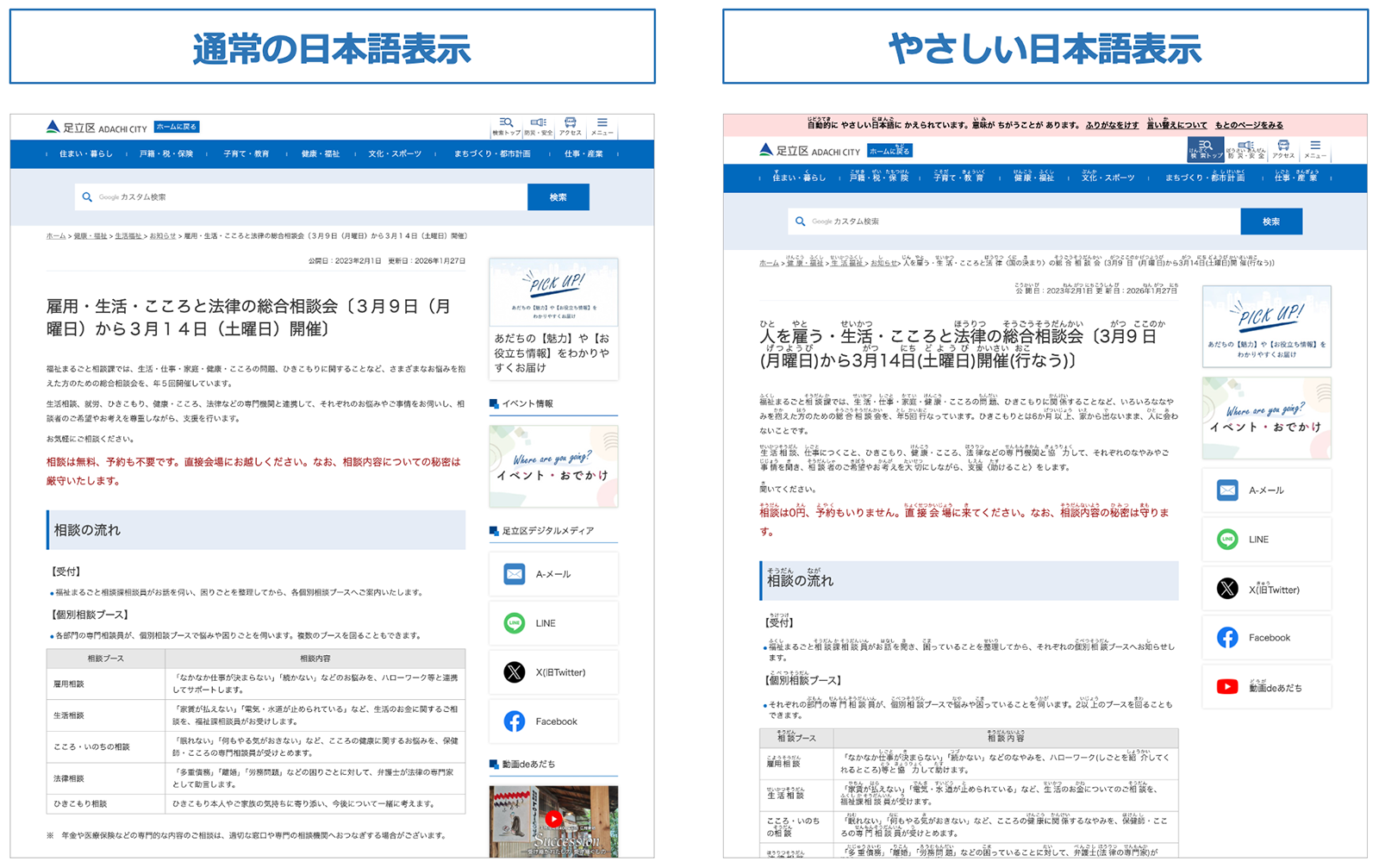
Adachi Ward began providing information in simplified Japanese in 2020, marking the first such initiative among Tokyo’s 23 wards. On Adachi Ward’s official website as well,You can switch between standard Japanese and simplified Japanese in the menuIt is designed so that you can select the display as needed.
◆Adachi City Official Website
Source: Quoted from the Adachi Ward official website
As you can see from the image, compared to the standard Japanese display,In the simplified Japanese version, kanji are accompanied by furigana, certain expressions have been rephrased, and additional explanations have been added.
◆Furigana, alternative phrasing, and supplementary explanations are added

Source: Quoted from the Adachi Ward official website
As a result, not only has the readability of headings and body text improved, butFor technical content, a brief explanation to clarify the meaning...is also included. "Easy Japanese" is not simply a matter of replacing kanji with hiragana, but rather,Efforts to organize information in a way that makes it easy for readers to understandThis case study clearly demonstrates that...
Another key feature of this case study is that it allows users to compare standard Japanese text with simplified Japanese text.Even with the same information, how well it is conveyed can vary greatly depending on how it is phrased and how explanations are supplementedThis makes it easy to understand visually. It is a prime example that will be very helpful for businesses looking to start implementing simplified Japanese.
Reference: Adachi City Official Website
The Importance of "Easy Japanese" in Web Accessibility
Web accessibility means thatA state in which everyone, regardless of age or disability, can use the websiteThis refers to the approach we take to create a website that is easy to use and understand for a diverse range of users, including those with visual impairments, older adults who have difficulty reading text, and foreign visitors who are not yet familiar with Japanese.
In Japan, under the "Amended Act on the Elimination of Discrimination against Persons with Disabilities,"With the requirement to provide reasonable accommodations for people with disabilities taking effect in 2024, websites are now also required to be accessible.
Simple Japanese plays a crucial role in achieving web accessibility. In this section, we will explain the importance of simple Japanese in web accessibility.
"WCAG" and "JIS X 8341-3," which are web accessibility standards
There are globally recognized standards for web accessibility.「WCAG(Web Content Accessibility Guidelines)」known as,International guidelines established by the W3C (Web standards organization).
In Japan, based on these WCAG guidelines"JIS X 8341-3"A national standard has been established. It is widely applied to the websites of public institutions and companies, and the Ministry of Internal Affairs and Communications’ guidelines alsoCompliance with JIS X 8341-3 is recommended.
For more information on WCAG and JIS X 8341-3, please refer to the article below.
Related Articles:WCAG is an international standard for accessibility based on four principles.
The Web Content Accessibility Guidelines (WCAG) outline various success criteria for web accessibility, and each criterion has three levels of conformance.
◆WCAG Conformity Levels
| Level | Positioning |
| A | Minimum requirements |
| AA | The standard level recommended by laws and guidelines |
| AAA | The highest standard for greater care |
The Act on the Elimination of Discrimination against Persons with Disabilities and the Ministry of Internal Affairs and Communications’ guidelines primarily require compliance up to the AA level. This is also the standard that many companies and local governments aim to meet.For a detailed explanation of exactly what actions are required, please refer to the article below.
Related Articles:What web accessibility measures must site managers implement?
"Easy Japanese" is closely aligned with the WCAG principles
WCAG isThe Four Principles (Perceptibility, Manipulability, Understandability, and Robustness)It consists of the following principles, among which the principle of "Understandability" is most closely related to Easy Japanese. Specifically, it corresponds to the following achievement standards.
◆The Relationship Between Easy-to-Read Japanese and WCAG Success Criteria
| WCAG Success Criteria | Level | The Relationship with Easy Japanese |
|---|---|---|
| 3.1.1 Page Language | A | Basic requirements for accurately indicating the page's language. While not "Easy Japanese" itself, it serves as a prerequisite. |
| 3.1.3 Uncommon Words | AAA | Request explanations of technical terms and idioms. This aligns with the approach of avoiding or clarifying difficult words. |
| 3.1.4 Abbreviations | AAA | Explain the meaning of the abbreviation. This overlaps with the approach of not abbreviating or providing additional context. |
| 3.1.5 Reading Level | AAA | When reading comprehension beyond the secondary school level is required, request supplementary materials or alternative versions. This is most closely related to "Easy Japanese." |
| 3.1.6 Pronunciation | AAA | Provides pronunciation cues for words whose reading is unknown. Overlaps with furigana. |
| 3.3.2 Label or description | A | Add labels and descriptions to input fields. This relates to clear instructions and error messages. |
As you can see from the table, many of the achievement standards for easy-to-read Japanese fall under Level AAA. In other words, this represents a level of consideration that goes beyond the scope of legal obligations (Level AA).
While AA compliance alone does not address the issue of text clarity,No matter how well-developed the technical accessibility features are, if the language used is too difficult, the information will not reach everyone.As a result, the site can no longer be considered accessible.
"Easy Japanese" is an initiative designed to support the understanding of all users, including the elderly, foreign nationals, and people with cognitive disabilities. From the perspective of web accessibility,Providing support in easy-to-understand Japanese goes beyond mere obligation; it is a fundamental consideration.
"UniWeb": Achieving Web Accessibility Compliance at Low Cost and in a Short Timeframe
Websites that do not currently comply with web accessibility standards must begin making improvements as soon as possible.
However,Web accessibility requires a high level of expertise, and when you factor in design revisions, implementation, and testing, it takes both time and money.It is difficult to handle entirely within the company, and it also creates an ongoing operational burden.
That’s where our service comes in handy.Web Accessibility Tool 'UniWeb'This is the implementation of UniWeb. By utilizing UniWeb,This makes it easier to move forward with accessibility improvements while adapting to the actual conditions of each website’s operations.
'UniWeb' isYou can get started immediately just by adding a tag to your siteYou can adjust the widget's appearance and settings from the admin panel. Site visitors can access the accessibility menu from,Over 30 accessibility featuresYou can customize the display to suit your preferences for readability and ease of use.
From an operational standpoint, the design allows us to keep pace with updates aligned with the latest industry standards, making it easier to approach accessibility not as a one-time initiative, but as an ongoing process of continuous improvement.
It also features a "Simple Japanese AI" function powered by generative AI
UniWeb features a "Simple Japanese AI" function that utilizes generative AI. This feature allows you to instantly look up the meaning of unfamiliar words or difficult sentences on the site in easy-to-understand Japanese.
◆UniWeb’s “Easy Japanese AI” Feature
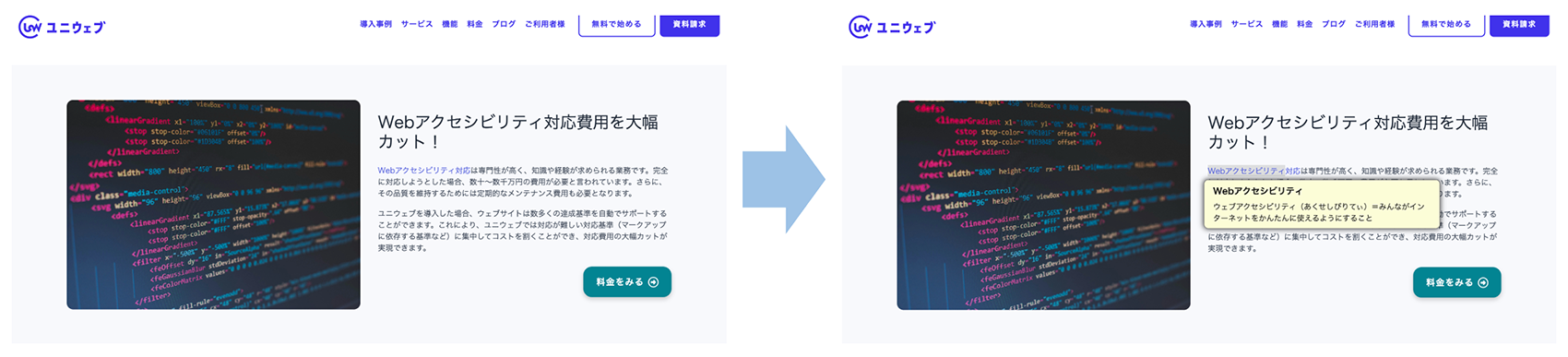
It's easy to use.
② Select "Easy Japanese AI" from the menu
③ Select any words or phrases you don’t understand
④ The content is displayed clearly on the spot
Because it rephrases difficult expressions or clarifies their meaning to aid understanding,A feature that is easy to use even on pages with a lot of technical jargon, as well as for procedural guides and important notices.
The actual behavior is,You can try it right away by clicking the "person icon" in the bottom right corner of this article.Try out UniWeb’s features and use them to identify specific areas for improvement on your company’s website.
Conclusion
Simple Japanese isn't just for foreigners;A method for conveying information in an easy-to-understand way to a diverse range of people, including the elderly and those with disabilitiesAs a result, its importance is growing. In today’s increasingly diverse society, where the number of foreign residents and people unfamiliar with Japanese is on the rise, providing information in easy-to-understand Japanese is becoming an increasingly important initiative for both government agencies and businesses.
In addition, websites must also take accessibility into account. This goes beyond simply ensuring text is easy to read and the site is user-friendly;Making the content itself easier to understand is also a key aspect of accessibility.
Therefore,Going forward, we will also work to incorporate simplified Japanese into our website operationsThis is important. By minimizing complex language and providing alternative phrasing or additional explanations where necessary, you can create a website that is accessible to a wider audience.
Simple Japanese is not a special initiative, but rather a “basic measure” designed to ensure that information reaches those who need it; there is no doubt that its importance will only continue to grow in the future.
Popular Articles
-

13 types of "easy-to-read fonts" and 3 key points on how to choose one.
-
Thorough illustrated explanation of 18 useful functions of AssistiveTouch
-
Eight "screen sharing tools" for novice users to choose from.
-
Explanation and examples of the "7 principles" for understanding universal design
-
Comparison of Siri, Google Assistant, and Alexa voice assistants
-
Contact Us
-
Request Info
-
Free Trial
-
Partner System